
Remembering the Great Jack Bruce
The great bassist-singer and former Cream frontman was born on this day in 1943

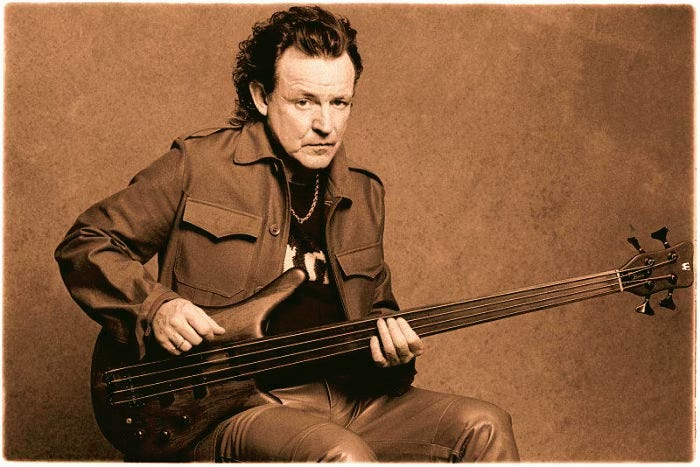
His urgent vocals on Cream classics like “Sunshine of Your Love,” “Politician” and “White Room” are forever etched on the memory banks of those of us who came up in the ‘60s. Add his raw, roaring, conversational bass lines on those endless Cream jams in concert or his fuzz-inflected bass lines on the title track to Frank Zappa’s 1974 album, Apostrophe, and you’ve got a shoe-in for the Rock & Roll Hall of Fame.
But there was much more to Jack Bruce than just those potent milestones.
Born in Glasgow, Scotland on May 14, 1943, he first played bass in Alex Korner’s Blues Inc. in 1962 (alongside future Rolling Stones drummer Charlie Watts) and in the Graham Bond Organisation in 1963 (alongside future Tony Williams Lifetime bandmate John McLaughlin). There followed brief stints with John Mayall’s Blues Breakers and Manfred Mann before forming the psychedelic blues-rock power trio Cream in 1966, debuting that year with Fresh Cream. The band went on to sell 35,000,000 albums in just over two years and was awarded the first ever platinum disc for a double album for 1968’s Wheels of Fire. Cream split in November 1968 at the height of their popularity and the following year Bruce released his solo debut album, Songs for a Tailor, which featured guest appearances from guitarists George Harrison and Chris Spedding. His second post-Cream album, 1970’s Things We Like, included guitarist John McLaughlin and prominently featured Bruce’s work on acoustic upright bass.
During his tenure with seminal fusion band Tony Williams Lifetime, Bruce appeared on 1970’s Turn It Over and 1971’s Ego. He also played a major vocal role on Carla Bley’s 1971 jazz opera, Escalator Over the Hill, while also playing bass alongside his guitar partner McLaughlin on a few tracks. There followed an early ‘70s stint (and three albums) with another power trio, West, Bruce and Laing (with guitarist Leslie West and drummer Corky Laing, both of the heavy-duty rock band Mountain).
Some of Bruce’s most potent appearances in the ‘80s came in collaboration with Kip Hanrahan, beginning with 1983’s exotic and provocative Desire Develops an Edge and including 1984’s Vertical Currency.
I was fortunate to have interviewed Jack on a couple of occasions during the ‘80s for Guitar World magazine. This one, from the April 1989 issue of GW, was in conjunction with his first major label release in a decade, A Questions of Time, an all-star outing featuring guest guitarists Allan Holdsworth, Vernon Reid, Albert Collins, Jimmy Ripp and Little Feat’s Paul Barrere along with appearance by keyboardist Bernie Worrell, tabla master Zakir Hussain and drummers Steve Jordan, Tony Williams and Bruce’s former Cream bandmate Ginger Baker.
IT’S 2 P.M. AND I’m running late. Jack Bruce sits in the midtown Manhattan offices of Epic Records, waiting, waiting, waiting. I am the captive of a subway train, hopelessly trapped in the city’s subterranean catacombs while a living legend sits and waits for me. We’re going no place fast. Apparently some hapless wretch has thrown himself on to the tracks up by Rockefeller Center, bringing all progress to a dead halt. A long conga line of trains has formed from the point of the unfortunate swan dive all the way downtown to the spot where I sit, mumbling obscenities...
I can’t believe this! Here I am trapped on the A train at the very moment I’m to have an audience with rock royalty. I mean, there are certain people you just don’t keep waiting. The President. The Pope. And Jack Bruce. Why couldn’t this calamity have befallen me the day I took the subway uptown to interview Floyd Rose or maybe Kim Simmons. But noooo! This mook would pick the day I’m set to interview the former bassist of Cream to throw himself onto the tracks. Just my luck!
I arrive at Epic frustrated and over forty minutes late. I imagine Jack breaking into a chorus of I’ve been waiting so long/to be where I’m going…
Informed of my arrival, Jack strides into the room, a pair of cold black shades ill-concealing a look of pity and con-tempt. He lifts the shades a touch and in his finest stern headmaster voice mockingly scolds: “So someone jumped on to the tracks. You call that an excuse?”
He actually has me going there for a second. But suddenly his hardy laugh breaks the tension and we get down to the business of discussing A Question Of Time, Jack’s latest solo project from Epic. “I wanted to get away from synthesizers on this record,” he begins, sounding slightly worn from the effects of jet lag on this promotional trip to New York. “I’ve done a certain amount of keyboard stuff, but on this record I really wanted to feature the guitar. I had the idea early on and just hammered away until I could put it in shape.”
His idea involved recruiting some heavy hitters as guest soloists. No less than Vernon Reid, Allan Holdsworth and Albert Collins take their turns in the spotlight on A Question Of Time, with stunning results. “Can you imagine getting all those musicians in the same room at different times?” he enthuses. “I was very lucky that the scheduling worked out. They were all very busy at the time, but they all made a point of fitting it in. I ended up getting everybody I had originally intended, with the exception of Steve Vai, who I wanted to play on the track ‘No Surrender.’ He couldn’t make it, though, because he had just joined Whitesnake So instead I got Jimmy Ripp, and that worked out real well. I had a good feeling about him from his playing with Mick Jagger, but I hadn’t heard him doing that Steve Vai kind of stuff. Sure enough, he delivered the goods!”
Jack raves about the soaring fretboard work of his longtime colleague Allan Holdsworth on “Obsession,” a tribal rocker with his former Cream bandmate Ginger Baker on drums that sounds curiously reminiscent of “Sunshine Of Your Love.”
“That’s a chilling kind of thing,” he says in awed tones. “That solo blows me away every time I hear it. To me, it is crafted like a great classical Indian sitar solo. I just love the shape of it. You hear this solo and you keep thinking, ‘Oh, it’s about to end now,’ and then Allan will stick in another run and then another run. He keeps going higher and higher with it. It’s incredible. He’s got a pair of ears like no one else. He hears things that nobody else hears and he certainly does things that nobody else can do. I think of him like I think of Jimi Hendrix... like he’s from another planet, musically”
Albert Collins digs in deep with typical ice-pick intensity on another album highlight, his scorching solo in Willie Dixon’s dirge-like “Blues You Can’t Lose.” “I wanted to do a ‘Spoonful’ kind of thing,” he says, referring to the Dixon tune that appeared on Cream’s iconic 1966 debut album, Fresh Cream. “A kind of White Kid From Glasgow Sings the Blues, if you like. I had heard this particular tune on Willie’s album of last year, Hidden Charms, and thought it would be the perfect vehicle. And I was definitely happy to have Albert Collins playing on that one. I think he’s one of the more underrated players around. He’s very unique, using his fingers and playing with a capo the way he does. And he has a very intense attack. He played an absolutely phenomenal set in San Francisco the night before we did the session. He set the place on fire. And he wasn’t just playing in the club, he was playing out on the street, with his patented hundred-foot cord. The night we cut the track he insisted on playing in the big room with the amp cranked up. Everybody else played their solos from the control room, but Albert refused. He said, ‘I wanna see my sound!’ So we let him wail.”
Living Colour’s guitarist Vernon Reid solos with typically ferocious abandon on the hard rocker “Life On Earth,” and the fleet-fingered Vivian Campbell gets in a few good licks at the tag of “Obsession” alongside Holdsworth. Even Jack’s son Malcolm has a go at it, on “Greasin’ The Wheel.”
Conspicuous by his absence from Jack’s star-studded guitar summit is, of course, Eric Clapton. When pressed for a reason why his old Cream-mate wasn’t included in the project, Jack smiles, strokes his chin and slyly states his position. “Ahh...this is a tricky little subject you’ve hit upon here,” he begins. “How do I get around this one? Well, the fact is, I definitely did not want Eric on this record, and I have very strong reasons why not. It will sound strange, but I’m going to say it anyway. I think if I had approached Eric and he had agreed to do it, it would’ve not been an honest and pure project. It would have been a compromise to approach him, and I’m not saying he would’ve wanted to have done it. A certain number of people around me were saying, ‘You must ask him to do it’ and I kept telling them, ‘No, I don’t want to.’ I’ve got my own reasons, and right or wrong, they’re my reasons. There wasn’t a track, really, that was right for Eric on this record anyway.”
Had Clapton appeared on “Obsession,” it would’ve been a Cream reunion. But Clapton is no Holdsworth. And having Clapton on board might simply have been pandering to nostalgia. Perhaps Jack is right. Whatever the case, he’s in no hurry to jump on the Sixties reunion bandwagon.
As it stands, Bruce’s explanation for excluding Eric from A Question Of Time could effectively be read as squelching any Cream reunions in the future. But fans can keep hoping. After their jam at New York’s Bottom Line last year, Jack reported the magic is still there. So who knows? 1991 will mark mark 25 years since Cream formed in England. A silver anniversary tour could be just the ticket.
There is, however, one other significant reunion on A Question Of Time. On the South African-influenced “Kwela,” Jack plays alongside his former employer, drummer great Tony Williams, who led the pioneering fusion outfit Lifetime that lasted from 1969 to 1971. That band’s inner intensity and sense of raucous abandon, fueled by Williams’ powerful drumming, Larry Young’s revolutionary Hammond organ work and John McLaughlin’s proto-punk attack on the guitar, set the tone for such groups as the Mahavishnu Orchestra, Return To Forever and The Eleventh House. Recalling those turbulent days with fondness, Jack says, “That band is still, for me, the high spot in my musical career. Obviously, the Cream days were fairly astounding. And the hard slough with Graham Bond, when we played some 340 gigs in one year, was invaluable for me in terms of getting my chops together. But Lifetime was a wonderful band. I sometimes try to figure out what it is that made it so unique. I mean, the energy, of course, and the high degree of musicianship were part of it. But there was something else. Something magical that I felt from that band.
Reunions aside, Jack is concentrating on his new album and his new band, which includes Baker on drums for half the night (Lounge Lizard Dougie Brown plays the first half, Bernie Worell and Blues Saraceno on guitar. “I’m real excited about going on the road and playing my new songs and some of the old stuff too. I would like to get some of the recognition for having written and sung most of the Cream songs. That’s one of the things I hope people realize from this record, that I can actually sing. Maybe I’ll even get some recognition from the Songwriter’s Hall Of Fame for my contributions to ‘Sunshine of Your Love,’ ‘White Room’ and ‘I Feel Free.’ You know, something corny like an award.”
Shortly after this Guitar World interview, in 1991, Bruce toured briefly with this wildly eclectic all-star ensemble featuring The Meters’ guitarist Leo Nocentelli and avant garde jazz pianist Don Pullen.
Fast-forward a few decades and Bruce was part of a supergroup with guitarist Vernon Reid, organist John Medeski and drummer Cindy Blackman. They record 2012’s Spectrum Road and went on tour in support of the album. Seeing them at the Blue Note in New York was a highlight of that year for me. Bruce passed shortly after, on October 25, 2014, at age 71, leaving behind a recorded legacy that boggles the mind.
I believe Songs for a Tailor was Bruce's second solo album, but the first released in the US. Things We Like was the first to be released in the UK.
i love Songs for a Tailor.
Jack was brilliant on so many levels: bassist, writer, vocalist, talent scout. I loved just about everything he tackled. (Well, I thought the Hanrahan stuff was shite, but that was Kip's fault, not Jack's.) Somewhere in my old college junk I have a big band arrangement I wrote for "Rope Ladder to the Moon"...