
Happy Birthday, John McLaughlin!
The undisputed guitar god and transcendent figure of my youth turns 84 today

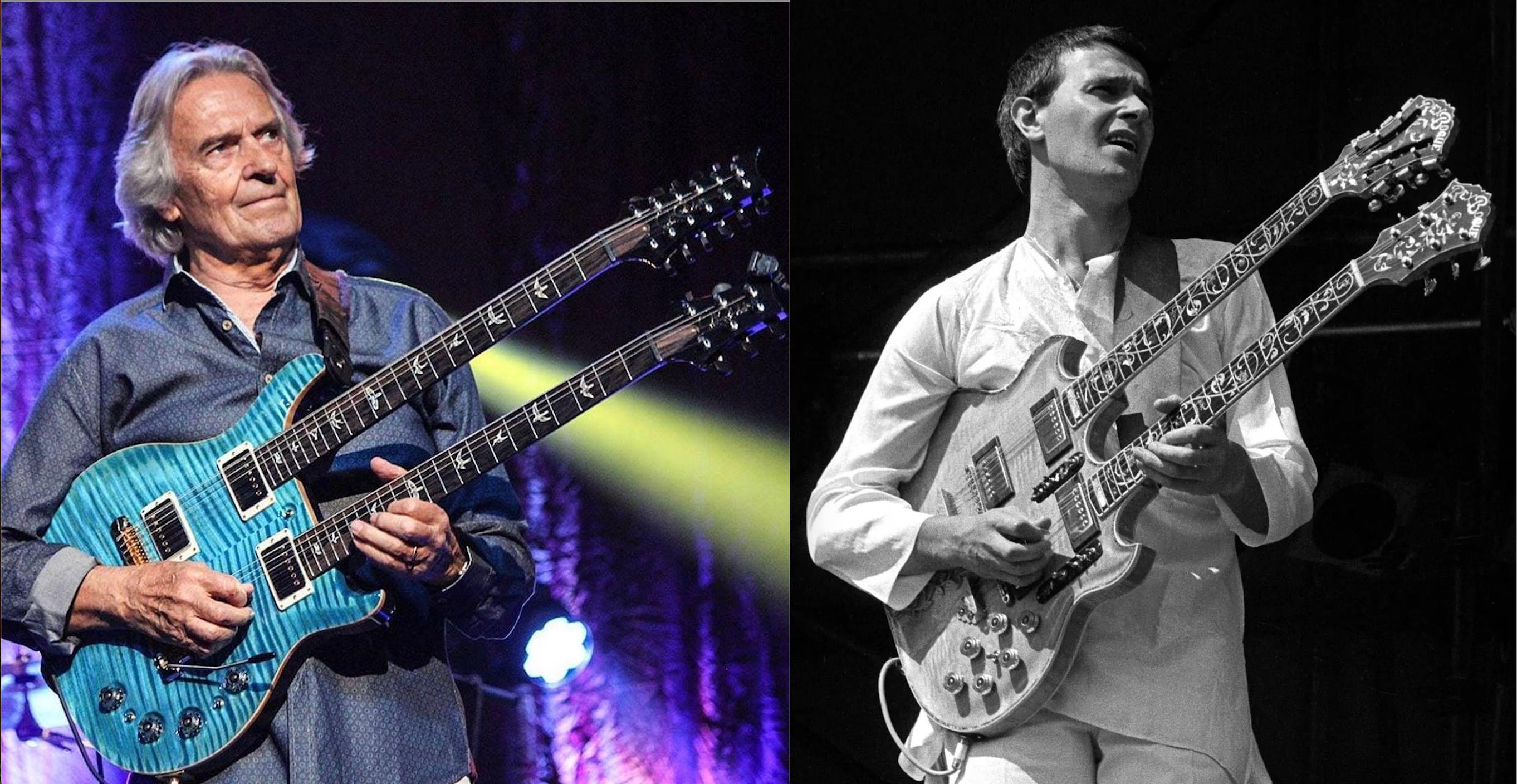
I have written about John McLaughlin for various publications over the decades, beginning with a 1978 interview I did for Cityside, a Milwaukee-based alternative news & entertainment publication that I also co-published with my partners Dan Ullrich and Michael Brickley. Since then I’ve had the pleasure of interviewing John more than a dozen times for Guitar Player, Guitar World, Jazz Times, Jazziz, Downbeat and other magazines, and over that time have never failed to be overwhelmed by his eloquence and erudition, as well as his warmth and good humor. Always outright and forthcoming in these numerous sit-downs we’ve done, he has touched on the politics of the day along with insights about his music and his unparalleled approach to the guitar, colorful reminiscences about his tenure with Miles Davis and his various encounters with other icons like Jaco Pastorius, Michael Brecker, Paco de Lucia and Billy Cobham. And I always came away from our chats uplifted and edified in some way.
I still have vivid memories of seeing John in concert for the first time. It was May 11, 1973 at the Milwaukee Arena, and the Mahavishnu Orchestra rode into my hometown on the strength of the group’s second scintillating album, Birds of Fire, released in January of that year. Mahavishnu shared a bill that pivotal night at the Milwaukee Auditorium with Frank Zappa and the Mothers of Invention, who premiered new material from their upcoming album, Over-Nite Sensation, which would be released in September of that year. And while my friends and I were psyched to hear Zappa, a guitar hero in his own right, I came away from that concert being completely blown away and awed by this angelic man dressed all in white who played with the speed picking ferocity of a six-string demon. As Zappa said of McLaughlin at the time: “The guy has certainly found out how to operate a guitar as if it were a machine gun.”
Three months after eye-opening gig in Milwaukee that I attended, the Mahavishnu Orchestra played the Schaefer Music Festival in New York’s Central Park (on Aug. 17 and 18, 1973, which was documented on the live album Between Nothingness & Eternity). Around that time, McLaughlin performed a one-off concert with an acoustic Indian flavored ensemble at Saint Thomas Episcopal Church in midtown Manhattan, marking the first public performance of Shakti. I would later see that incredible East-meets-West group on their first Stateside tour when they opened for Weather Report on May 18, 1976, at the Riverside Theater in Milwaukee.
Since that time, I have witnessed McLaughlin in concert with the One Truth Band in 1978, with The Guitar Trio featuring Al Di Meola and Paco de Lucia in 1980, with The Translators featuring Katia Labeque on synths and Tommy Campbell on drums in 1982 followed by a 1984 incarnation of the Mahavishnu Orchestra with Bill Evans on saxophone, Jonas Hellborg on bass, Mitch Forman on keyboards and Danny Gottlieb on drums and again in 1986 with Jim Beard on keyboards. I also saw John in various trio configurations between 1987 and 1992 with Trilok Gurtu on drums/percussion and either Jonas Hellborg, Kai Eckhardt or Dominique Di Piazza on bass. I caught him again in 1996 with his Free Spirits organ trio featuring Joey DeFrancesco and drummer Dennis Chambers and in 1997 with his The Heart of Things band featuring bassist Matthew Garrison, tenor saxophonist Gary Thomas, keyboardist Jim Beard and drummer Chambers. Shortly after that, John formed a new incarnation of Shakti (now dubbed Remember Shakti with the marvelous mandolin maestro U. Shrinivas replacing violinist L. Shankar in the group). I first caught that extraordinary group at the Montreal Jazz Festival in 1999, followed by performances at the Beacon Theatre in New York on Nov. 5, 2000, Central Park Summerstage on June 28, 2001, and again at Town Hall on Oct. 3, 2003.
On September 27, 2007, McLaughlin unveiled his 4th Dimension Band with the young French bass phenom Hadrien Feraud, keyboardist Gary Husband and drummer Mark Mondesir at a Town Hall concert. Then in April 2009, John appeared along with Chick Corea, bassist Christian McBride, alto saxophonist Kenny Garrett and drummer Brian Blade as The Five Peace Band in a series of concerts at Jazz at Lincoln Center’s Rose Theatre. He would later return to Town Hall with his 4th Dimension Band for a Nov. 13, 2010 performance with keyboardist-drummer Gary Husband, bassist Etienne M'Bappé and drummer Mark Mondesir.
In July of 2011, I caught John trading licks with fellow guitarist Mike Stern at the Nice Jazz Festival (McLaughlin was there with his 4th Dimension Band while Stern was there in a band with French violinist Didier Lockwood, bassist Tom Kennedy and drummer Dave Weckl, and the two guitar heroes ended up jamming on Miles Davis’ “Jean Pierre” with a quote from Jimi Hendrix’s “Third Stone From the Sun” thrown in for good measure). Then in June of 2013, John brought his 4th Dimension Band into New York for a four night stand at the Blue Note with Ranjit Barot, Etienne Mbappe and Gary Husband, and I attended every night. Later that year, in October of 2013, I was part of an intimate gathering to witness John playing duets at the Metropolitan Museum of Art with pianist Gary Husband in a demonstration of Paul Reed Smith Guitars, following a ceremony in which the luthier presented one of his custom instruments to be part of the permanent display at the museum.
On Dec. 10, 2016, McLaughlin appeared at the Blue Note in a special Return To Forever-meets-Mahavishnu Orchestra concert (with Lenny White on drums, Victor Wooten on bass and guests Bela Fleck on banjo, Kenny Garrett on alto sax and Wallace Roney on trumpet) as part of Chick Corea’s annual eight-week residency at the New York City nightclub.
Then on Nov. 3, 2017, McLaughlin played Town Hall one last time in what was announced as his farewell concert. An inherited progressive arthritic condition in his right hand was forcing him into semi-retirement. As he explained to me at the time, “The American tour is it for me, because the situation with my hands is deteriorating. Short of a miracle, I think that’ll probably be it, at least in terms of touring.” Enter American doctor Joe Dispenza, who helped heal McLaughlin’s arthritic hand through meditation and the power of a “mind-body connection” that has caused spontaneous remission in countless others. “He’s something else,” said the guitar avatar of Dr. Dispenza. “I had never met him, I just read about his technique. He had his back broken in three places and healed himself. And I said, ‘If he can fix his back in three places, I can fix my hand.’ And I did. I’m still working on it every day, but there’s no swelling, no pain. It’s far out, man!”
For that 2017 Town Hall concert, McLaughlin’s 4th Dimension Band was joined by Herring’s group, The Invisible Whip, which joined them onstage for a grand finale of Mahavishnu classics like “Dance of Maya” and “Birds of Fire.”
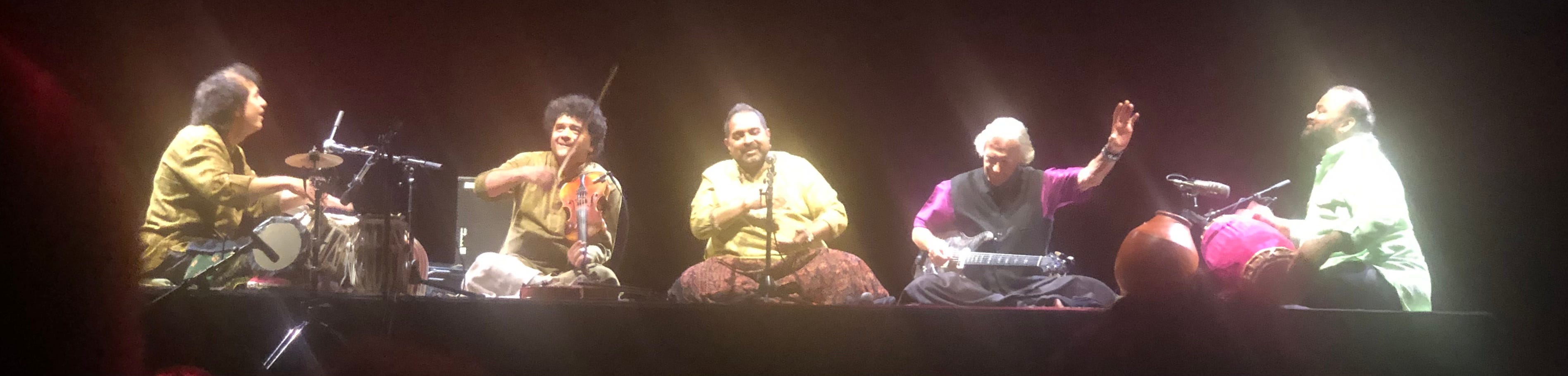
During the pandemic, while sequestered at his home in Monaco, McLaughlin recorded two albums — 2020’s Is That So? with Shakti mates Shankar Mahadevan on vocals and longtime partner Zakir Hussain on tablas, and 2021’s Liberation Time (both on the Abstract Logix label). He followed that by celebrating his 80th year with a triumphant 4th Dimension Band tour of Europe in 2022. Following the June 30, 2022 release of This Moment (Abstract Logix), McLaughlin was ready to hit the road once again, this time with Shakti, the pioneering Indo-jazz supergroup he formed with Zakir Hussain in 1973.
In May of 2023, McLaughlin performed at a Royal Albert Hall tribute to his friend and fellow guitar hero Jeff Beck, who had passed on Jan. 10, 2023. Then in June, he embarked on a world tour with Shakti in celebration of the group’s 50th Anniversary (the American tour began in August). I was overjoyed to catch this amazing group on Aug. 19 at the Capitol Theater in Port Chester, New York. It was a memorable concert and turned out to be the last time I would see tabla master Zakir Hussain, who passed away on Dec. 15, 2024. I was honored to have interviewed both John and Zakir for a Downbeat cover story (July 2023 issue) on their unique history and chemistry together on the eve of Shakti’s triumphant 50th Anniversary tour.
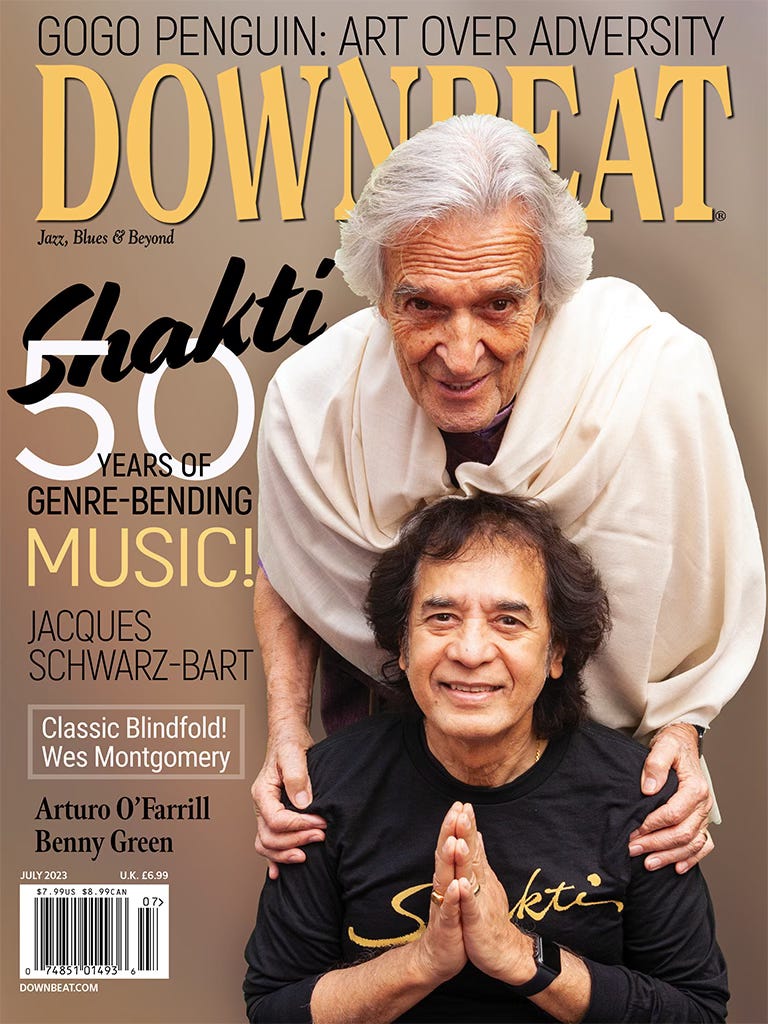
Funny how in this Jazz Times interview below, from 1992, I seemed perplexed by the fact that John was turning 50. Well, here we are 34 years later, and the guitar hero of my youth has just turned 84. And he is still very much on top of his game, as his recent soundtrack album, Music from Abandoned Heights, will attest.
John McLaughlin: Past, Present & Future
By Bill Milkowski
The streaks of grey in his hair give John McLaughlin a distinguished professorial look. The red bow tie adds a touch of Continental class. He wears it well: it’s just hard for me to accept that my boyhood hero has turned 50.
Twenty-three years have passed since he travelled from England to the United States to play with Tony Williams’ Lifetime and Miles Davis. Those were trailblazing days. People like Miles and Tony were leading the way down a new path, exploring a marriage between the language of jazz and the visceral power of rock... something that Jimi Hendrix had only hinted at. And John McLaughlin was a key player on that exciting new scene. Through his scintillating work with Lifetime, Miles, and his own Mahavishnu Orchestra, he had become the living link between Jimi and John Coltrane and stood as a towering influence on a generation of musicians.
Some people say the fusion movement fizzled by the mid-’70s; the once-dynamic genre reduced to a critical joke. But by then, John was into another bag with Shakti, a revolutionary ensemble that fused the structures and discipline of Indian classical with jazz-like improvisation. Like his main mentor Miles, he kept moving forward. And there were several landmarks along the way -- his return to electric music on 1978’s Johnny McLaughlin: Electric Guitarist; the formation of his One Truth Band in 1979 and his appearance at the “Havana Jam” in Cuba that same year with an all-star band called Trio of Doom, featuring bassist Jaco Pastorius and drummer Tony Williams; the triumphant acoustic guitar trio tour in 1980 with Al Di Meola and Paco de Lucia, yielding the Grammy Award-winning Friday Night in San Francisco; his revival of the Mahavishnu band (in name only) in 1984; his appearance with Herbie Hancock and Dexter Gordon in the 1986 film ‘Round Midnight; the formation of his current trio in 1988 with Indian percussion master Trilok Gurtu and a succession of incredible electric bassists (Jeff Berlin, Kai Eckhardt, and now French phenom Dominique Di Piazza).
As I enter his hotel suite in Manhattan, John appears jovial and ready for his week-long engagement with the trio at the Blue Note. He is sitting on a couch, tuning his beautiful hand-crafted flame maple acoustic guitars, made for him by the great luthier Abraham Wechter, who also built his customized Shakti guitars back in 1976. As he rips off a few stunning licks it’s clear that he’s fully recovered from the career-threatening, freak household accident that occurred in 1990. While watching TV at home in France, John got his lefthand forefinger caught in the track of a swiveling television set. As he recalled at the time, “It was so quick, so fast. I heard it snap, I saw the end of my finger flopping around... it was just a nightmare.”
Six stitches and a splint put that finger right, but the injury forced John to cancel a Stateside tour with his trio. Now with the release of Que Alegria, his debut on Verve, the trio is out touring with renewed vigor. And John is once again playing beautiful music with, as Coltrane put it in his notes to A Love Supreme: “elation, elegance and exaltation.”
I’m fascinated by the transitional period in ‘68 - ‘69 when jazz and rock started coming together. And to me, the first so-called fusion album that really grabbed rock fans was Jack Johnson. Miles had flirted with rock forms on In A Silent Way and Bitches Brew. But there was something about the raw power of Jack Johnson...I mean, you’re playing power chords on that album like Pete Townsend!
Well, you know, that was Miles’ favorite record. You know how the majority of Jack Johnson came about? The bulk of that record came out of some jamming we did in the studio. There was Herbie playing the most horrible Farfisa organ and Michael Henderson on bass, Billy Cobham on drums. We were all in the studio, just waiting for Miles. He was talking to Teo Macero in another room and that went on for 10-15 minutes, and I got bored. I started to play a boogie in E, just to have some fun, that’s all. I was playing those funny kind of chords that later I used to more advantage in “Dance of Maya” (from 1971’s The Inner Mounting Flame)... kind of angular chords but all really related to the blues. That’s what “Dance of Maya” is, a blues in E, really, with some funny angular chords. And I was really hitting the strings hard, just going for it. Billy picked it up, Michael picked it up and in a couple of minutes we were gone. So finally the door opened and Miles ran in with his trumpet. The (recording) light was on and he just played for about 20 minutes, which I had never seen him do before. It was a situation where he just walked in and everything was happening already. And he played so fine. It was so spontaneous, such a great moment. That whole record was.
It sounds like maybe you should have gotten a co-composer credit for some of that album.
No, there was no tune. Why even bother to discuss who wrote what? What happened with all the musicians who played with Miles in the studio was strictly Miles’ doing. Let’s make that perfectly clear. Miles’ records were always quite carefully directed by him, orchestrated in a way that was not quite obvious. Because he had that thing, that ability to be able to make musicians play in a way that they would not normally think of. He had a way of pulling things out of them that they were unaware of. He certainly did it to me. So it was absolutely Miles’ vision... the way the concepts would go. I think we have to put the credit on Miles. We all had ideas. Everybody would come up with things... a riff or a motif. But they were all really in function of Miles and his music. We were only concerned with what we could do to contribute to what he was playing. And I think everybody more or less had that same idea. So it’s a kind of useless question: who wrote what? Because the concept and the way the music grew and was recorded was truly, absolutely Miles. And I think that was true even in the latter days, when he got more into funk and hip-hop. I know a lot of people mocked Miles for that, but not me. To me, Miles could do no wrong.
What was your impression of the Miles tribute concert you attended in Paris last summer?
I was very moved, personally. To see Miles with all those people representing all those years of music... to see him walk on stage with Wayne again... to see him playing with Jackie McLean again was something else. And of course, the In A Silent Way band was a highlight with Joe (Zawinul) and Chick (Corea). Actually, I didn’t play in that band. I played on two pieces, “Jean Pierre” (from We Want Miles) and “Katia” (from You’re Under Arrest). Darryl Jones was on bass, Al Foster on drums, John Scofield was also playing guitar. The way Miles set it up, each tune... as was Miles’ wont... had a kind of opposition element happening. He would pair up players... Scofield and myself, Wayne (Shorter) and Bill Evans, Jackie McLean and Steve Grossman, Herbie and Chick... so that there were always two soloists on the same instrument, which was nice for us. I don’t get much chance to play with Scofield, whom I love. He’s such a great player. So every tune was from a different era... different feeling, different sound, different attitude. Each piece had its own life to it. And it’s just amazing to think that it all came from one person. Overall, I think the whole event had a very powerful impact on Miles. Everybody was so happy to be there. It was like his birthday party. I really regret that a couple of musicians who should’ve been there couldn’t make it. Keith (Jarrett) should’ve been there. Tony Williams should’ve been there. Jack DeJohnette should’ve been there. They were very much a part of his groups over the years. For whatever reasons they weren’t there, but a lot of musicians did show up. Just to see this whole amazing canvas of music, played briefly in condensed form... it was like repainting a picture. It was an amazing event and a very moving experience. In fact, at the end Miles didn’t want to see anybody except Katia, my girl, who he had met about ten years ago. I introduced them to each other. She was talking to him in his dresssing room after the show and he was being so nostalgic about what had happened. After the show he went to Italy. We talked on the phone briefly and I told him how happy I had been just to be there. And he said he really enjoyed the whole concert.
How did he seem to you at the time?
I could see that Miles was not in top form, health-wise. And I was a little worried about it. But for many years I had been worried about him. I remember 16 years ago I was in his house with Herbie and we both thought he was gonna die. This was 1976. We had to help him into the hospital. I thought he was gonna die then. But he had always been very tough, very resilient. You could never imagine that Miles would die. It’s like family. You never think that anyone in your family is gonna die. But I think he must’ve had an idea at that Paris concert. Because when he went in the hospital later he had double pneumonia and bronchitis and had one heart attack. Around that time I was speaking to Peter Shukat, who was an old friend of mine and had been handling Miles for the last few years. And I would ask Peter, “Does he want to live? Does he really want to?” And Peter would say, “I don’t know.” This was most worrying of all. Because you can get sick but you need the will to get better. And nobody knew if he had it at that point.
That was true of Jaco (Pastorius) in the end. So many people who knew him thought he was going to die years before it actually happened. Some people thought he was indestructible because he always bounced back from whatever he put himself through. But at some point, he gave up.
I agree with you. I saw Jaco quite some time before he died and I agree. I think he had given up already, and that really, really hurt me. Because he was a young man with such talent... I mean, how can you give up?
Some of his closest friends were really angry at him for that.
Yeah, I’m angry myself. I’m still angry about it. Yeah, it was sad. I met Jaco in 1973, before he joined Weather Report. He arrived (in New York) from Miami and found out where I was rehearsing. I had a great bass guitar player at the time in Ralphe Armstrong but Jaco came by and basically said, “I wanna play.” He was such a live wire, so full of vitality. So we jammed and he was amazing. He was looking for a gig and was broke. I loaned him money to get his car fixed and he paid me back 11 years later. I called Tony and said,”You should hear this bass player. This guy is amazing.” But Jaco went back down to Florida and eventually hooked up with Joe and Wayne, and that was the start of a beautiful period. I actually got to know him better around ‘76-’77 when Shakti did a lot of touring with Weather Report in the U.S. and Europe. Every night we would be checking each other out and it was really a wonderful combination because the two bands were so different. Jaco was playing so great then and Weather Report was such a great band. They really had a great impact on contemporary music. And to see Jaco in his element was wonderful. So I knew him very well during his heyday. Then I saw him at Seventh Avenue South some years later and I was really shocked. He was drunk, acting crazy. He just seemed like a different person. You could see it in his eyes. But even so, I don’t thinkwe can ignore the great music that he made with Weather Report and on his own. These are great records, in my opinion. And Jaco played outstandingly on them. But something happened. Something happened to his mind during that period so that instead of evolving he was devolving.
So what happened at the “Havana Jam” with the Trio of Doom?
It was such a shame. Tony and Jaco and I had rehearsed here in New York, and what a trio that was! What a pleasure it was to play with them! Tony and Jaco were just so much together. After one rehearsal, we actually went in to record with Joni Mitchell (for her Mingus album). We recorded one tune and then later they wiped Tony and me off the tracks, which I thought was a shame. But rehearsals were happening and we went down to Havana with high expectations. We each had a tune that we brought into the trio. We started off our set with my tune, “Dark Prince,” which is an uptempo C minor blues with altered changes. It was really a chance to stretch, but Jaco just threw the music down, walked back to his amp, turned it up to 11 and started playing A major really loud against it. I was looking at Tony like, “what is going on here?” It was nothing like the rehearsals. He did the same to Tony’s tune. Then he went out and did his whole audience routine. It was a fiasco. The Bay of Gigs. And I was so mad at Jaco. He came off stage saying, “Yeah, man, that was the shit!” and all this. And I told him, “I have never been more ashamed in my life to be on stage with somebody. That was the worst shit I ever heard in my life. I don’t wanna see your face for at least a week.” I really was mad at him. Tony was mad at the time but he wouldn’t say anything. But he got mad later. We went into the studio later to try to do something but there was a big fight between them... not really a big fight. Tony just flipped out and smashed his drums and walked out of the studio. And that really tore Jaco to strips. So it was evident to me during this period that something was going on with Jaco that didn’t really have too much to do with music. There was something happening in his mind. I don’t know what it was. It was some kind of idea or image of himself of what he had to do or what he was supposed to do. And it was really crazy. It certainly had nothing to do with what we were playing. It was strictly showtime. It was sad. But you can never take away from what he’s done. He single-handedly revolutionized bass guitar... his sound, his chords, his harmonics. I mean, Jaco just blew the shit open. It’s amazing what he did to bass guitar.
I’m sure Dominique Di Piazza would attest to that. You can hear a lot of Jaco in his playing.
Of course. Dominique is a great player. But even today, Jaco stays unique. In the bass guitar firmament, he’s unique. And nothing can take that away. Nothing. Whatever happened afterward is just tragic. Because we all loved Jaco. He was a loveable guy. He had his faults too but who doesn’t? He was a lovely person. And everybody just wanted him to... to be alive and just play. That’s what we’re here for.
And when I put on your new album and heard Dominique I thought...
Jaco is alive! It’s like Coltrane. You can listen to almost any saxophone player today and you think, “Trane is alive and well.” It’s amazing. It’s beautiful to see. And for that, we can only thank people like Jaco. And Dominique, yeah, he’s really working on his instrument, trying to fing his own way, which is difficult even in the best of times. But I think he’s doing a great job. He plays very well.
It was very generous of you to feature him on that one track, “ Marie.”
It’s beautiful what he’s doing there. Solo bass, it’s rare. I think the only other person who did that is Jaco. And I encourage Dominique to keep going as much as he can in his own direction, to grow and evolve. He’s been with us a little over a year now. And I think the group is the most complete version of this trio. Whereas before, Trilok and I had a very strong complicity, almost to the exclusion of the bass player sometimes... not by choice but just the music goes. And since Dominique’s been with us, I’m starting to have a complicity with him that balances things more. We do a lot of unison playing together, which is something that goes back to bebop, exemplified by Charlie Parker and Dizzy Gillespie. I love that. It’s been a part of my music all along, even with Shakti. Curiously enough, unison playing is a tradition you find in India too. And Dominique is capable of doing it. This is one of the aspects of this complicity that is growing between Dominique and myself. We have this kind of guitaristic relationship developing that’s very interesting. And I still have a great complicity between the two of them. And so the group itself becomes more whole now than it’s ever been. The record is great, but some things have started to happen in live situations that are truly amazing. It’s like we planted a flower that’s blossoming now.
You have such a strong hookup with Trilok.
Well, Trilok is an Indian musician by training and a jazz musician by affection, so we have a lot in common. He can shift at a moment’s notice from an Indian groove to an Elvin Jones kind of groove. So we’re able to move together in a very easy way... very instant communication. At any point, we can dramatically change the musical derivative, and this means we have a big field to play in. We’re not restricted to just one or two particular ways of communicating. And he has a great sense of humor too in the way he plays. I love humor. I take myself very seriously but there’s a point beyond which you take yourself so seriously you get heavy. And I don’t want that to happen to the music.
Are you doing any other playing outside the trio?
Yes, I continue to play with a symphony orchestra. I do several concerts a year. I have a couple scheduled with a great American orchestra, the New World Symphony in Miami, which is an orchestra of musicians between the ages of 20 and 35. We have two concerts scheduled in November. It’s my second concerto and we’ll probably record it sometime next year. I also have a group with Katia and Marielle Labeque (world reknowned classical piano duo) which only exists in Europe called 20th Century Living. The music is all by 20th century composers, classical and jazz...Stravinsky, Bartok, Bernstein, arrangements of Monk tunes with everything written out. In Europe we’re able to play with this group in great concert halls and have really mixed audiences, classical and jazz. It works very well. We tried to get some gigs over here but nobody’s interested. The difference is, in Europe you have art subsidies, whereby the governments contribute money to make these programs happen. They see them as cultural events that need to be promoted simply because it’s a good cultural event, that’s all. You don’t need another reason.
That’s the failing of shortsighted American politicians. They don’t see the connection between cultural events and social problems.
Exactly, and when I see symphony orchestras going bankrupt in America, this really frightens me.
The group that is supposed to be funding artistic expression in the States, the National Endowment for the Arts, is being raped by the Bush Administration and the whole fundamentalist right wing.
Well, money is petrol in the motor, isn’t it? No money, no orchestras.
So we may never see you perform with this group?
It’s unlikely, yeah.
Other than that gig you played with Miles last summer, you probably don’t have much use for electric guitar these days?
Not at all. Not since I formed this trio back in ‘88. I’ve been concentrating strictly on acoustic gut string guitar, which is the guitar I discovered when I was 11. So maybe I’m reverting back to my childhood. But there’s definitely something there for me. I love the tone and it’s a very percussive instrument, much more responsive in the upper register than a steel string guitar. No comparison. But I would like to play electric guitar again some day. As a matter of fact, I would like to record with Elvin and a Hammond organ player, and for that I would have to play on electric guitar. Or with Tony. I love those guys. Tony is still today the great revolutionary on drums. And Elvin, who I never had the chance to play with, is so much a part of my growing up... listening to him and Trane. I really like this idea.
Elvin did a record last year with Sonny Sharrock (Ask The Ages, Axiom) that was a very powerful blowing album.
Really! I haven’t heard Sonny Sharrock in a long time. I remember playing with Sonny on one of Wayne’s records, Super Nova (1969, Blue Note). I knew Sonny from back in 1968 when we played the Berlin Anti-Festival together.
Does your switch to acoustic guitar have anything to do with hearing loss from playing so loud with electric guitar?
No, although I do have a little dip around 4K, but just a small one. So I’m in pretty good shape. Actually, I have other problems with listening to loud music. When it’s above a certain volume I really miss the tenderness that’s part of music, part of human life... the subtlety and feelings. And that all goes by the board for me when everything’s cranked up. I’m not interested in doing that. I don’t want to blast people, I want them to go into the music. I don’t want to confront them with a wall of pressure. I’m convinced, personally, if the music is open, if it has more space in it, then the listener’s mind will go inside and his or her imagination will start to play inside the music. And that, for me, is really what’s happening. At that point, the listener becomes lost in an individual sense and is found in a greater sense, just as we are when we play the music. And if we are able to do it, then the listener is going to be able to do it. And the music will be able to do it’s thing, which is, in fact, heal. That’s the great power of music. It heals the human spirit. So I am convinced now that people shouldn’t be bombarded with music. Maybe I did before, but 20 years ago was another era... the Vietnam war and the whole thing... Freedom Now, the black intellectual movement and how it was repressed, flower power, LSD and all of that, where we were going... it was a very different period. Certainly for me. So I consider things differently today. And I see things actually differently. And for me, I would like to see more space and more subtleties in music. Because the act of listening to music is very intimate, as is to play. And if some kind of intimate action can take place inside the music, I think this is what’s really happening.
So how do you feel now that you’re so immersed in more intimate acoustic music about being confronted by your own electric past? In the last couple of years, Columbia has reissued Jack Johnson and Johnny McLaughlin: Electric Guitarist, for instance.
They’re great, I love them. They’re all part of me. And today there’s still a Johnny McLaughlin Electric Guitarist inside me. I love that too, but it’s another way. And I don’t rule out the possibility of playing the electric guitar again, especially if I get a chance to do something, as I say, with Elvin or do something with Tony again. But I don’t know about the sound anymore. What you hear on Que Alegria, that’s what my sound is all about now. That’s my voice now. And I don’t know if it’s feasible to play an acoustic guitar with somebody bashing drums. That’s tough. This guitar doesn’t like it. At a certain volume, she freaks out. And the only way to get around that is to plug in the electric guitar. And I don’t know what my voice is on that instrument anymore. It would require going back to the lab and finding out where my head is at as far as an electric sound is concerned. Maybe it’ll come back quick, maybe it won’t. I don’t know.
That’s a whole other woodshedding period.
You bet it is. And I may find the time, even if it’s just a couple of days, to go in the studio and thrash around and flounder and find out what I don’t like. Sometimes by the process of elimination you find out where you need to go. So we’ll see what happens.
I recently saw a bootleg album of that jam you and Hendrix did together. It was selling for something like $40.
What a ripoff! There was not too much to that. It was just like a party in the studio. That was never intended to be released.
That’s been happening with Jaco... so much inferior stuff has come out since he died, some of it’s just Walkman recordings in nightclubs.
That’s terrible, but what are you gonna do? These people have no scruples. They have no honor. They’re just looking to make a buck off a dead man’s name. It’s really a shame. This just disgusts me. They’re just mercenaries with no morals, these people. But they’re out there, so what can we do?
Keep playing.
That’s it. That’s all we can do.
My musical life changed when as a 15 years old in 1973, I walked into a record store and heard wondrous things. Up until this point I had followed the musical tastes of my elder brother, who was into British progressive music. He even attended the second Isle of Wight Pop Festival. That day I heard A Love Supreme and Birds of Fire. Nothing was ever the same. I got into Sri Chinmoy ( even started wearing white clothing...yikes! ) saw the 1974 Mahavishnu then delved into McLaughlin's jazz beginnings in both the UK and the US. Extrapolation remains one of my favorite albums. The first two Mahavishnu albums are simply two of the greatest recordings ever made. Shakti was new,fresh and quite different but just as inspiring. I also got into Coltrane and hard bop, ECM records and numerous other jazz avenues and stop offs,leading me to where I am now 53 years later. The hairs still stand up on the back of my neck listening to McLaughlin's double-necked Gibson and that incredible tone. Happy days!
Left out the Emerald's band with Narada Michael Walden saw them on a double bill with Jeff Beck. Saw the Chambers / DiFrancesco trio at the Bottom Line. Listen to Bitches Brew on vinyl a lot. Not much to say but thanks for these deep dives. John made music for the soul to soar. My horizons were expanded as were all of ours... possibly the last of the great adventures into the unknown possibilities. There's a new generation coming up like Samara Joy who might take the genre into uncharted realms, but it's been a while. Central Park '73 did it. Thanks for the Dr. Meditation tip we're all getting older but better.